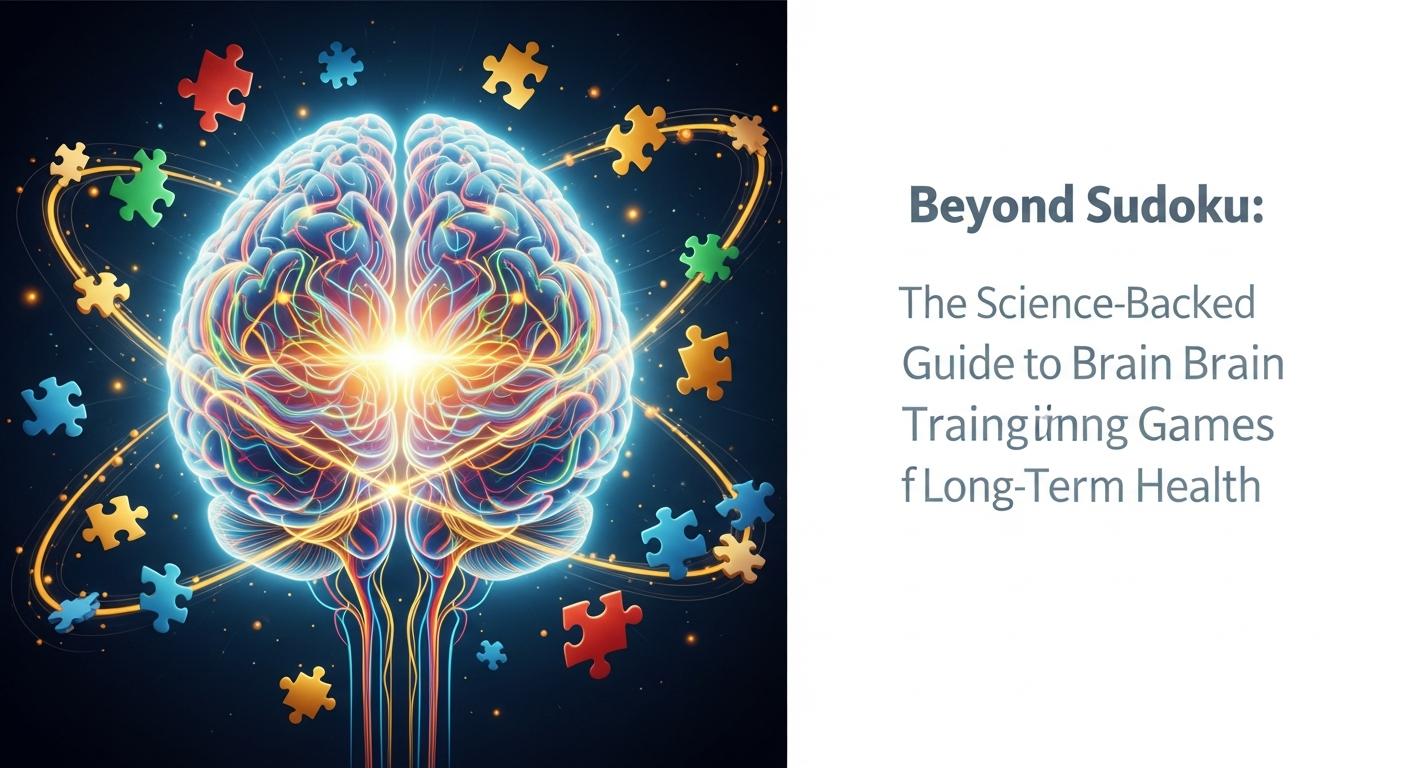
#Introduction: The Concept of the 'Digital Brain Gym' and Why Mental Fitness Matters
For decades, we have been conditioned to think about physical fitness as a lifelong commitment. We hit the gym, track our steps, and monitor our heart rates to ensure our bodies remain resilient as we age. However, when it came to the brain, the prevailing wisdom was often reactive: we only started worrying about cognitive health when we noticed "senior moments" or significant lapses in recall. Today, a paradigm shift is occurring. We are entering the era of the "Digital Brain Gym," where brain training games are no longer just a pastime for the retired, but a vital form of preventative maintenance for adults of all ages.
At the heart of this movement is the concept of "Cognitive Reserve." Think of this as a mental savings account. Every time you engage in challenging mental activities, you are making a deposit. This reserve doesn't just make you sharper today; it builds a buffer against future age-related decline and neurological pathology. By engaging in structured cognitive games for adults, you are essentially "thickening" the neural networks that allow your brain to find alternative routes when primary pathways are damaged or worn down by time.
The goal of a modern mental fitness routine isn't just to get better at a specific puzzle. It is about fostering a brain that is adaptable, quick, and resilient. In this guide, we will move beyond the basic Sunday crossword and explore the science-backed world of digital cognitive training, showing you how to turn your smartphone into a high-performance tool for long-term brain health.
Key Takeaway: Cognitive health should be treated as preventative maintenance. Building "Cognitive Reserve" through regular mental exercise creates a buffer that protects the brain against future decline.
#The Science of Neuroplasticity: How Cognitive Games for Adults Reshape the Brain
For a long time, scientists believed that the adult brain was relatively static—that once you reached a certain age, your neural wiring was "fixed." We now know this is false. The discovery of neuroplasticity—the brain’s ability to reorganize itself by forming new neural connections throughout life—changed everything. When you engage in targeted neuroplasticity exercises, you are physically altering the structure of your brain, strengthening the synapses that facilitate communication between neurons.
When we play sophisticated cognitive games for adults, we aren't just memorizing patterns; we are forcing the brain to adapt to new rules and novel stimuli. This process stimulates the production of neurotrophic factors, which are proteins that support the survival and growth of neurons. It’s the neurological equivalent of "lifting weights." As the game increases in complexity, the brain must recruit more resources, leading to increased white matter integrity and improved cortical thickness in areas responsible for attention and executive function.
However, not all games are created equal. To truly trigger neuroplasticity, a task must be novel and challenging. If you play the same type of puzzle every day for years, you eventually reach a plateau where your brain becomes so efficient at that specific task that it no longer needs to grow. The magic happens at the edge of your ability, where the brain is forced to "rewire" itself to meet the new demand.
Key Takeaway: Neuroplasticity allows the adult brain to grow and adapt. To trigger this growth, cognitive exercises must be novel and increasingly difficult to prevent the brain from hitting a developmental plateau.
#Memory Improvement Games: Moving Beyond Rote Memorization to Functional Recall
When people think of memory improvement games, they often picture memorizing long lists of random words or decks of cards. While these are impressive feats, they don't always translate to the type of memory we need in daily life. Modern cognitive science focuses on "Working Memory"—the ability to hold and manipulate information in your mind over short periods. This is the "RAM" of your brain, and it is essential for everything from following complex instructions to participating in a fast-paced conversation.
Effective working memory training involves tasks like the "n-back" test, where you must keep track of a stimulus that appeared several steps ago. This forces the brain to constantly update its internal records, discarding old information and integrating new data. Unlike rote memorization, this type of training strengthens the prefrontal cortex, the area of the brain responsible for high-level decision-making and focus. By improving your working memory, you aren't just better at remembering names; you become better at processing information in real-time.
Furthermore, functional recall training helps bridge the gap between "knowing" and "doing." Games that require you to remember spatial locations or the sequence of events in a narrative help reinforce the pathways used for navigation and logical reasoning. This is why modern brain training games often incorporate storytelling or spatial puzzles; they mimic the complex ways we use memory in the real world, ensuring that the "gains" you make in the app show up in your daily productivity.
Key Takeaway: Focus on "Working Memory" rather than rote memorization. Training your brain to manipulate and update information in real-time provides the most significant boost to daily cognitive performance.
#The Mental Agility App Revolution: What to Look for in a Science-Based Training Tool
The marketplace is flooded with "brain games," but not all of them are built on a foundation of clinical research. When selecting a mental agility app, it is crucial to look for tools that have been validated by peer-reviewed studies. A high-quality mental agility app should offer more than just entertainment; it should provide a comprehensive assessment of your baseline cognitive functions and tailor its curriculum to your specific strengths and weaknesses.
Key features to look for in brain health apps include variety and adaptivity. A good app will rotate through different cognitive domains—such as processing speed, attention, flexibility, and problem-solving—to ensure a "full-body" mental workout. More importantly, it should use algorithms to adjust the difficulty in real-time. If the game is too easy, you aren't building reserve; if it’s too hard, you’ll likely quit. The best apps keep you in a state of "flow," where the challenge perfectly matches your current skill level.
Additionally, transparency is vital. Reputable apps will often provide data on how your scores compare to your age group and offer insights into which specific cognitive functions you are working on. Look for developers who collaborate with neuroscientists and universities. In the world of brain training games, the difference between a "game" and a "training tool" lies in the data and the methodology behind the interface.
Key Takeaway: Choose apps that are backed by peer-reviewed science and offer adaptive difficulty. A well-rounded tool should target multiple cognitive domains rather than just one.
#Why Puzzle Games for Brain Health Require 'The Goldilocks Zone' of Difficulty
There is a common misconception that simply doing "hard" puzzles is the best way to stay sharp. However, cognitive science suggests that there is a "Goldilocks Zone"—a sweet spot of difficulty that is "just right" for triggering neural growth. If puzzle games for brain health are too simple, your brain operates on autopilot, and no new neural pathways are formed. Conversely, if a game is overwhelmingly difficult, it triggers a stress response that can actually inhibit learning and lead to mental fatigue.
The Goldilocks Zone is technically known as the "Zone of Proximal Development." This is the area where you can perform a task with a bit of a struggle, but you are still successful. When you are in this zone, your brain is fully engaged, dopamine levels are optimized for learning, and you are more likely to experience "flow." This state of deep immersion is where the most significant neuroplasticity exercises occur, as the brain is fully committed to the task at hand.
To stay in this zone, you must constantly vary your routine. Once you become a master at Sudoku, its effectiveness as a brain-training tool diminishes. To continue growing, you need to switch to something that feels "clunky" and "new" again—perhaps a game focused on spatial rotation or linguistic logic. Embracing the discomfort of being a beginner is the secret to long-term cognitive vitality.
Key Takeaway: Maximum brain growth occurs in the "Goldilocks Zone"—the space where a task is challenging but achievable. Once a game becomes easy, it’s time to switch to a new type of challenge.
#The Transferability Problem: Making Sure Game Skills Translate to Real-World Productivity
One of the biggest critiques of early brain training games was the "transferability problem." Critics argued that playing a game that required you to track moving bubbles only made you better at tracking moving bubbles—it didn't help you drive a car or manage a project. Modern executive function games are designed specifically to solve this problem by targeting the "core" cognitive processes that underpin almost every real-world action.
Executive functions include things like inhibitory control (staying focused despite distractions), cognitive flexibility (switching between tasks), and planning. When you play games that target these specific areas, the benefits are much more likely to "transfer" to your professional and personal life. For example, a game that requires you to quickly switch between different rules can improve your ability to multitask in a busy office environment. A game that trains inhibitory control can help you stay focused during long meetings or while reading a complex document.
The key to ensuring transferability is to choose cognitive games for adults that mimic real-world complexity. Look for games that require you to prioritize tasks, filter out "noise," and make quick decisions under pressure. By training the underlying "engines" of thought, you ensure that the time you spend in the digital gym pays dividends in your actual life, resulting in better focus, faster problem-solving, and improved emotional regulation.
Key Takeaway: To ensure your training translates to real life, focus on games that exercise "executive functions" like focus, task-switching, and impulse control.
#A Holistic Approach: Combining Brain Training Games with Sleep, Diet, and Social Interaction
While brain training games are a powerful tool, they do not exist in a vacuum. You cannot "game" your way out of a poor lifestyle. To maximize the benefits of your mental agility app, you must support your brain with the biological foundations it needs to function. Think of brain games as the software, and your physical health as the hardware. If the hardware is failing, the software won't run efficiently.
Sleep is perhaps the most critical factor. It is during sleep that the brain clears out metabolic waste and consolidates the neural connections made during your training sessions. Without adequate rest, the "plasticity" you are trying to trigger simply won't stick. Similarly, a diet rich in omega-3 fatty acids, antioxidants, and complex carbohydrates provides the fuel necessary for high-level cognitive processing. Physical exercise also plays a role by increasing blood flow to the brain and releasing BDNF (Brain-Derived Neurotrophic Factor), which acts like fertilizer for new neurons.
Finally, do not underestimate the power of social interaction. Engaging in a complex conversation is one of the most demanding cognitive games for adults there is. It requires listening, processing, empathy, and rapid-fire response. Combining digital training with a rich social life and healthy physical habits creates a synergistic effect that significantly boosts your cognitive reserve and overall quality of life.
Key Takeaway: Brain training is most effective when combined with healthy sleep, nutrition, and social engagement. Physical health provides the "hardware" that allows cognitive "software" to thrive.
#Conclusion: Creating a Sustainable 15-Minute Daily Mental Agility Routine
The journey to long-term brain health doesn't require hours of grueling study. In fact, the most effective approach is consistency over intensity. Research suggests that just 15 to 20 minutes of targeted cognitive exercise per day can yield significant improvements in processing speed and memory over time. The goal is to make "mental agility" as much a part of your morning as your cup of coffee.
To start your own routine, follow these three steps:
Diversify: Pick three different brain health apps or games that target different areas (e.g., one for memory, one for focus, one for logic).
Schedule: Anchor your training to an existing habit. Play your games while on the train, during your lunch break, or immediately after your workout.
Audit: Every month, assess your progress. If a game feels like it's becoming "easy," swap it out for a new challenge to stay in the Goldilocks Zone.
By treating your cognitive health as a form of "preventative maintenance," you aren't just playing games; you are investing in your future self. Start today by downloading a science-backed mental agility app and dedicating just 15 minutes to your "Digital Brain Gym." Your future brain will thank you for the deposits you're making today.
Ready to level up? Don't wait for your memory to slip before you take action. Choose one new cognitive challenge today and commit to a week of daily practice. The path to a sharper, more resilient mind starts with a single tap.
Read next
See all →
The Science of Sharpness: Why a Daily Trivia Quiz is Your Best Morning Ritual
Start your day with a mental spark. This article explores the science behind daily trivia quizzes and how micro-learning habits can improve long-term cognitive health and focus.
Beyond Sudoku: The Science-Backed Guide to Brain Training Games for Adults
Move beyond basic puzzles with this comprehensive guide to science-backed brain training. Learn how modern cognitive games can enhance memory, executive function, and overall neuroplasticity.
The Power of the Daily Trivia Quiz: Why 10 Minutes a Day Makes You Smarter
Discover how a daily trivia quiz can transform your cognitive health through the power of micro-learning. Learn why spending just 10 minutes a day on a quiz of the day builds lasting general knowledge and sharpens your focus.